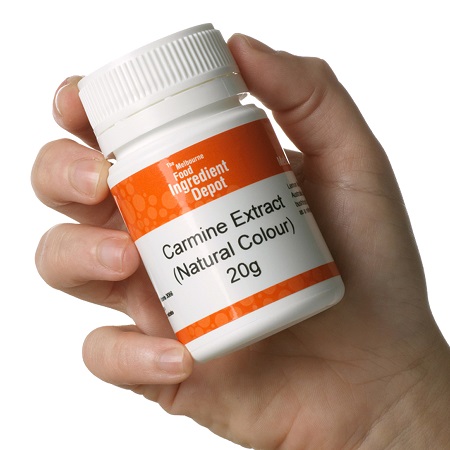
Let’s first take a look on Carmine definition:
“Carmine – is a pigment of a bright-red color obtained from the aluminium complex derived from carminic acid. Its specific code name is E120. Carmine is also a general term for a particularly deep-red color (Wikipedia, 2024).”
It sounds very technical and not so willing to really explain the pigment origin. But let’s dig deeper and find another definition written in common language…
“Carmine, red or purplish-red pigment obtained from cochineal, a red dyestuff extracted from the dried bodies of certain female scale insects native to tropical and subtropical America (Britannica, 2024)”.

And this is a FOOD ADDITIVE. We eat it and drink it. And so do our children…
How does the industry obtain carmine?
First the insects are collected manually from cacti, where they parasitize, feeding on the sap of plants.
Then they are dried in the sun or using other methods to preserve their pigments.
After drying the insects are boiled in water in order to extract the carmine acid. Then the carminic acid is isolated and purified.
In order to improve the quality of the dye, it can be treated with aluminum or calcium salts, which intensifies the color.
Dye E120 is widely used in the food industry (in sweets, yogurts, drinks) and in cosmetics (for example, in lipsticks), as well as in the textile industry for dyeing fabrics.
This dye is considered natural, because it really comes from nature. But this is not what you think when “contains only natural colour additives” appears on the package.
By the way, due to its origin, this dye is not vegan.
So now you tell me, would you really like to consume it and to turn it into a part of your body? Will you check the ingredient list next time to ensure this E120 is not there?
Please do it!
Reference List
- Britannica (2024). Carmine. [Online]. Available at: https://www.britannica.com/technology/carmine [Accessed 23 October 2024]
- Harvard University (2024). Cochineal image [photo]. Available at: https://hmsc.harvard.edu/online-exhibits/cochineal1/product-nature/ [Accessed 23 October 2024]
- Melbourn Food Ingredient Depot (2024). Carmine Extract Powder image [photo]. Available at: https://www.melbournefooddepot.com/buy/carmine-extract-powder-natural-20g/F05480 [Accessed 23 October 2024]
- Wikipedia (2024). Carmine. [Online]. Available at: https://en.wikipedia.org/wiki/Carmine [Accessed 23 October 2024]



Leave Your Opinion